NYT article: "Crown Heights Gets Its Turn"

Comments
-
"Some of that development includes condominiums, a sure sign that the initial wave of young, single students and professionals that arrived in the 2000s is now being followed by a second, more affluent, wave of professionals and families."I'd agree with that description for the rectangle defined by EP, Washington, Atlantic and Nostrand.A friend of mine and I recently had a discussion in which he commented, "When I moved here in 2000, this area was 12% white and 88% other. By 2020, I expect it to be completely reversed: 88% white and 12% other."Given the present interaction between wealth, income, education and preferences, I see his prediction as being spot on.
-
@whynot_31 When do you expect that description to apply to the whole of Crown Heights, and what do you feel is holding it back?
-
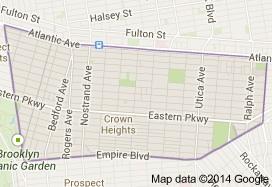 I'd argue that there is no "whole of Crown Heights".I'd answer you in terms of 5 separate areas:1. The area defined above.2. The area defined by Nostrand, EP, Albany and Atlantic.3. The area defined by Washington, EP, Nostrand and Empire4. The "Lubavitch Area": Nostrand, EP, Troy, Empire5. The area defined by Albany, Atlantic, Saratoga, ENY Ave/Empire.Areas 2 - 5 have not seen the same influx of "young, single students and professionals" to the same degree as Area 1 for many reasons.
 -
Areas 2 - 5 have not seen the same influx of "young, single students and professionals" to the same degree as Area 1 for many reasons.I'm trying to understand some of those reasons...Also, I'm not sure I agree with area 4. I would define it as Nostrand, EP, Utica (or Schenectady if you insist, but definitely not Troy), Empire.
-
Agreed, and hereby revise 4 to:4. Nostrand, EP, Utica, Empire.Do you find each of the 5 areas equally attractive? I.E. If you had $2k a month to spend on housing and didn't see anything you liked in area 1, which area would you next choose?Note:a. You might choose "none of the above" and live in an area outside of Crown Heights.b. Your preferences would likely be influenced by a very complex set of factors.
-
No; I do not find these areas equally attractive. In order of preference, I would next choose area 2, 4, 3, none.
-
If enough people had your same preferences and means, that would be the order in which Crown Heights changes.
-
I'm not sure I follow. I'm trying to understand why the other areas have not seen same influx of "young, single students and professionals" to the same degree as Area 1.At one point (say, 10-15 years ago), my order of preference would have been drastically different. Area 1 would most likely not be preferable over the others, particularity as one gets closer to Nostrand. However (per my understanding), as Clinton Hill and Prospect Heights became more attractive and expensive, Area 1 became a nearby alternative option.So, is it simply that Area 1 is still relatively affordable but once that is not the case, the "young, single students and professionals" will venture into other areas, or are there other reasons?
-
That's part of it, but by no means the whole story. Let's think about area 1.-Not to be coy, but a big part of its appeal is who is already there. Nothing draws a crowd, like crowd.How did it get the crowd initially?Not only was it on the eastern edge rapidly gentrifying Prospect Heights, it also had the ability to be "reborn". The vacant Jewish Hospital Complex became hundreds of apartments, and lots of new residential construction on vacant lots came online between 2005 and 2009.The other areas described will experience this to a lesser degree. For example, they have fewer vacant lots and don't have a large vacant hospital complex. As a result, the other areas are less likely to be attractive or affordable to 20 somethings in their first "real" job because there is no new crowd to draw a crowd.Returning to present day Area 1:As the article implies, its newest residents are now not only older, but wear worn college sweatshirts on weekends that proclaim private, non-liberal arts, grad schools.You can see them at Centanni and Barbachino. They are the ones eating, not the ones serving the food.
-
Thanks @whynot_31. Makes sense. I didn't think of the vacant lots and the vacant hospital complex and how they contributed.
-
Now that the vacant lots are almost gone in area 1, we are starting to see "under capitalized and low ROI properties" be demolished for new residential:
-churches
-single story parking garages and warehouses
-old houses on large lots -
/ basic retail
-single story parking garages and warehouses
aka "taxpayers" -
I don't think it should be separated as such. I think they should be separated by spheres of influence of the commercial roads. For example, Washington Avenue, Franklin Avenue, Nostrand Avenue, and Utica Avenue, all have slightly different vibes and different types of people live around them.I live just east of Nostrand and i can say that the same type of people that have been moving to Franklin and Washington have been moving here since the summer of last year. It's been weird seeing change happen so quickly. The brownstone I live in is being renovated for new tenants, several people have also renovated their own on my block and have sold them. The buildings across the street from me have been/are being renovated and several families have moved in.Crown Heights easily takes the cake for fastest gentrifying neighborhood.
-
The Lower East Side was incredibly fast as well, roughly 1995 - 2005.
It may have changed faster. -
"How did it get the crowd initially?"
Well, allot people back in early 2000, were unsure where Prospect hts ended and Crown Hts was unknown/forgotten history a little. Then the Realators figured out the area east of Washington and The old hospital could be marketed as Prospect Hts living. Bait and switch? All good cuz Crown Hts is reborn and unique to itself. -
Saw this on Twitter.NYTimes on Crown Heights
1970 http://nyti.ms/1jr9l0N
1983 http://nyti.ms/1jr9OAc
1985 http://nyti.ms/1jr8TzO
2014 http://nyti.ms/1jr91z8 -
I found this quote to be interesting: ''The support we have received,'' Mr. Cherry said, ''shows that there is an interest in achieving a balance between gentrification and displacement." Can this balance be found in CH again or attempted?
-
I found this quote to be interesting (from 1985): ''The support we have received,'' Mr. Cherry said, ''shows that there is an interest in achieving a balance between gentrification and displacement." Can this balance be found in CH again or attempted?
-
In retrospect, that was the time to start encouraging the community to buy the land and Participate in ownership.
-
@southeast
IN 1985......"Houses, when available, range from about $125,000 to $150,000. One that
sold recently for $125,000 paid taxes of about $1,000. Studios rent for
$300 to $350 a month and one- and two-bedrooms range from $400 to $600.
Co-ops along Eastern Parkway average $20,000 a room."
-
For extra points, a reader should dig up the median incomes for the area during those years.
Then, we could see how the new prices correlate to the new incomes.
...then, we'd add things like household wealth, because income and wealth are often distinct. -
We're you ever a teacher? This sounds like some old story problems.
-
This story is as old as humanity.
-
As someone who was attempting to sell subsidized condos in 1990 in Crown Heights, the irony is that no one wanted to buy in the neighborhood because it was so depressed. That's really laughable given what we know now.
-
When parents grow old , estates are settled and siblings choose to sell the house they grew up in instead of sharing ownership, neighborhoods start to change hands. The sellers participate in change as much as buyers.
-
I found this quote to be interesting (from 1985): ''The support we have received,'' Mr. Cherry said, ''shows that there is an interest in achieving a balance between gentrification and displacement." Can this balance be found in CH again or attempted?
Assuming he is still alive, I'd love to meet Mr. Cheery and see if he still views 1985 as a fair, equitable period.
I'm not sure I want to go back to the circumstances that lead to NYC taking the steps it did in 1985.
I certainly don't see those circumstances as being present now.
-
@ capt. planet -
The founder of TerraCRG thinks it won't be long before developers start creating condos, because the scarcity of them is starting to make them more profitable than rentals.
I do love pendulums.
http://www.brownstoner.com/blog/2014/07/the-hot-seat-ofer-cohen/
-
Actually, when we were looking to buy four-five years ago, we looked at a lot of condos in Crown Heights -- the one we bought on St. Marks, one on Pacific and Brooklyn I think, one on Bergen between Utica and Rochester, one on Sterling between Troy and Schenectady, one on Prospect and Buffalo, and one on Albany between Sterling and St. Johns. Plus two just past the southern border of Crown Heights. But then all the inventory seemed to dry up.
-
My freinds tried to buy a condo near Franklin 3 years ago but the developer dragged the processout so long , like for over a year , they had to drop it and buy something else in another hood. Seems the developer was watching the value rise and had options. anyone else see that happen? Seemed really unfair at the time.
-
I'd like to read an article that covers the soaring values of land zoned residential.
I suspect Crown Heights is among the neighborhoods with the highest % gain over the past few years.


Howdy, Stranger!
Categories
- 40K All Categories
- 27.1K Neighborhoods
- 5.1K Crown Heights/Prospect Lefferts Gardens
- 7.1K Prospect Heights
- 2.3K Fort Greene, Clinton Hill, Bed-Stuy
- 8K Park Slope
- 549 Williamsburg, Greenpoint, Bushwick
- 442 Flatbush/Midwood/Ditmas Park
- 657 BoCoCa (Boerum Hill, Cobble Hill, Carroll Gardens)
- 151 Red Hook
- 104 Gowanus
- 304 Bay Ridge/Bensonhurst
- 130 Coney Island, Brighton Beach, Sheepshead Bay
- 270 Brooklyn Heights, DUMBO and Downtown
- 598 Windsor Terrace / Kensington
- 673 Greenwood Heights and Sunset Park
- 749 Brooklyn and Beyond
- 6.3K Stuff
- 86 Brooklyn Back When
- 1.2K Brooklyn Pets
- 257 Brooklyn Kids
- 241 Brooklyn Eats
- 51 Brooklyn Booze
- 3.6K The Lounge / Random Stuff
- 611 Brooklyn Politics
- 122 Brooklyn Sports and Fitness
- 111 Brooklyn Photos
- 339 Site Issues
- 8 Frequently Asked Questions (FAQ)
- 6.2K Listings
- 1.1K APARTMENTS and REAL ESTATE
- 1.3K Sales Openings Events
- 2.3K The Classifieds